Introduction
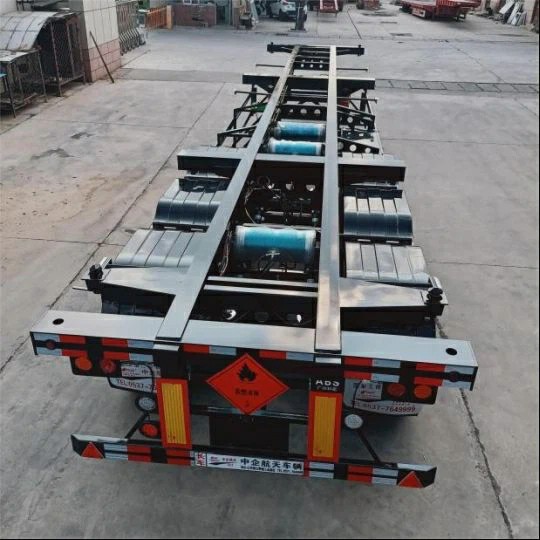
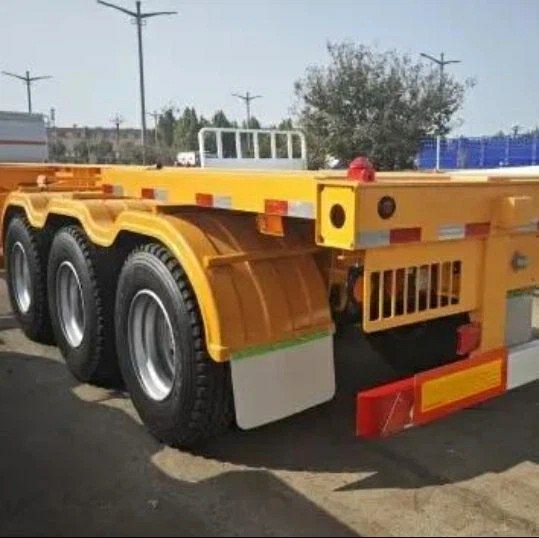
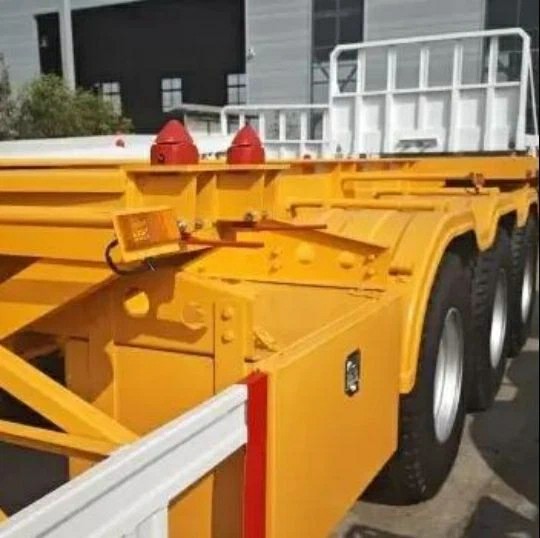
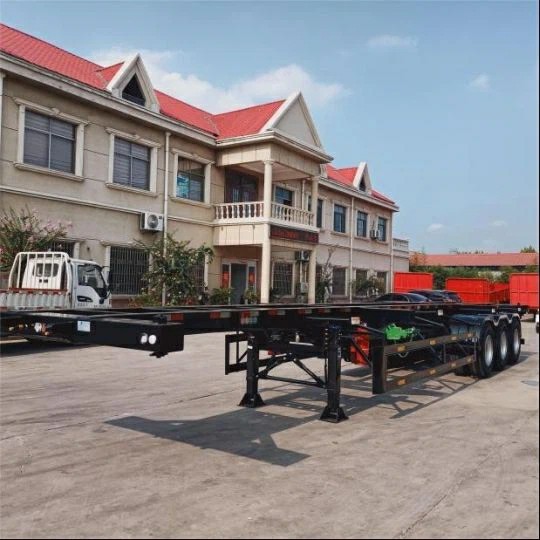
The 40-foot container chassis semi-trailer is made of high-strength steel, serving as an efficient transfer equipment for ports and multimodal transportation scenarios.
Details
Specifically designed for 40-foot standard containers, it achieves "efficient adaptation + safe transportation".
The frame dimensions fully match 40-foot standard containers, with quick fixation via locking devices-no additional modification required, ensuring high loading and unloading efficiency.
The rational layout of chassis crossbeams and locking devices firmly secures containers, preventing displacement during transportation, ensuring safety and stability, and adapting to long-distance trunk transportation scenarios.
Product Parameters
|
Category |
Specific Parameters |
|
Basic Dimension Parameters |
Overall Dimensions: Common specifications include 12240×2480×1550mm, 12400×2480×1410mm, etc.; some models can reach 13000×3000×1650mm. Wheelbase: Mostly 3-axle distributions such as 6880+1310+1310mm, 7545+1310+1310mm. Kingpin Setting: Approximately 950mm from the front crossbeam; specifications optional: 2 inches (50mm) or 3.5 inches (90mm), mostly Jost type. |
|
Weight and Bearing Parameters |
Curb Weight: Usually 5800-9000kg; conventional 3-axle models are about 5800kg, heavy-duty models can reach 9000kg. Rated Load Capacity: Generally 34200-60000kg; mainstream models have a rated load of 40 tons, and heavy-duty versions can reach 60 tons. Gross Vehicle Weight Rating (GVWR): Corresponding to 40000-69000kg, matching the sum of load capacity and curb weight. |
|
Frame and Structure Parameters |
Main Beam: Height 480-500mm; upper flange 10-16mm, lower flange 12-18mm, web 6-10mm; crossbeams are mostly 16# channel steel. Frame Material: Main beams adopt Q345B high-strength steel; some high-end models use T700 steel, welded via automatic submerged arc welding process. Locking Device Configuration: 12 sets of twist locks in total, including 4 fixed locks and 8 retractable locks, adapting to 1×40-foot or 2×20-foot standard containers. |
|
Chassis and Running System Parameters |
Axles: Standard 3-axle; optional load levels: 13t, 16t, 20t; main brands: BPW, FUWA, Wondee; some support 150,000 km maintenance-free. Suspension System: Mainstream is mechanical leaf spring suspension, equipped with 10 pieces of 90×13mm or 6 pieces of 90×16mm springs; optional BPW/FUWA air suspension. Tires and Rims: Tire specifications optional: 11.00R20, 12R22.5, 385/65R22.5, etc., 12 tires in total; rims are mostly 8.25-22.5 or 9.00-22.5 tubeless steel rims. |
|
Braking and Electrical System Parameters |
Braking System: Dual-circuit pneumatic braking, equipped with Wabco RE-6 emergency relay valve; each axle is equipped with T30/30 spring brake air chamber; ABS anti-lock braking system optional. Electrical System: Voltage 24V; adopts 7-pin ISO standard socket; equipped with LED turn signals, brake lights, side lights and reflectors; cables protected by PVC pipes. |
|
Other Configuration Parameters |
Support Legs: 28-ton class dual-speed linked support legs; optional brands: Jost, FUWA, etc. Accessories: Standard 1 steel toolbox, 1-2 spare tire racks; some include on-board tools. Painting Process: Sandblasting to SA2.5 level; coated with primer + 2 layers of topcoat, using polyurethane coating; color customizable. |
Applications
In ports and terminals, it serves as the hub for container land transfer, adapting to narrow yard passages and frequent loading/unloading needs, significantly improving terminal operation efficiency.
In multimodal transportation, it plays a "link" role, seamlessly connecting sea, railway, and road transportation. Containers received from ports can be directly transferred to inland logistics, making it a core tool for cross-border trade and domestic long-distance logistics.
In the field of professional cargo transportation, its adaptability is extremely strong: it can carry containers of piece goods such as electronic products, home appliances, and daily necessities; it can also transport heavy building materials like construction steel and cement prefabricated parts through special containers; it can even be customized with fixing schemes to adapt to special goods such as large mechanical equipment and wind power accessories, meeting the needs of multiple industries including industry, agriculture, and infrastructure.
In addition, it is widely used in logistics parks and warehousing centers, becoming a key support for the efficient operation of modern logistics.